Summary in the Video
Explanation in the video
The ‘Overview, Summary, or Conclusion’ of this article can be found at the beginning of the YouTube video, so please refer to it.
If possible, we would appreciate it if you could subscribe to our channel to help maintain the site. It serves as motivation for us!
Introduction
This video series is structured around four major works by Émile Durkheim.
- The Division of Labor in Society (1893)
- The Rules of Sociological Method (1895)
- Suicide: A Study in Sociology (1897)
- The Elementary Forms of Religious Life (1912)
First, here is the overall structure of Durkheim’s The Division of Labor in Society.
This article focuses specifically on Durkheim’s critique of Tönnies.
The remaining topics will be discussed in the next video.
If you find this video helpful, please consider subscribing to the channel. It will motivate me to create the next one.
- Chronology
- What are the bonds that connect people to one another?
- What is division of labor and what are its functions?
- Why does division of labor produce social solidarity?
- [Column] What is sociology?
- The difference between mechanical solidarity and organic solidarity
- The difference between segmentary society and organized society
- Collective conscience and collective representations
- [Column] What is sociological theory?
- Examination of solidarity: repressive law and restitutive law
- Non-contractual elements in contracts
- A society without crime is unhealthy
- [Column] Durkheim’s critique of Tönnies
- Is individualism detrimental to solidarity?
- Coercive division of labor and anomic division of labor
- Intermediate groups as a measure against the adverse effects of modernization
(2-1) Basic Concepts in Ferdinand Tönnies
First, let us review the core of Tönnies’s argument.
#
POINTGemeinschaft: Gemeinschaft is a term that means a form of community based on organic, affective, and traditional bonds, such as family (kinship ties) and rural society (local ties), grounded in will shaped by custom, emotion, and tradition.
#
#
POINTGesellschaft:Gesellschaft is a term that means an interest-based society. It refers to voluntary associations found in large cities and nation-states, where individuals are connected through intentional and artificial forms of organization. Typical examples include commercial organizations such as business firms.
#
Whereas Gemeinschaft embodies a durable and authentic form of communal life grounded in trust, Gesellschaft is regarded as a temporary and superficial construct formed in accordance with specific instrumental purposes.
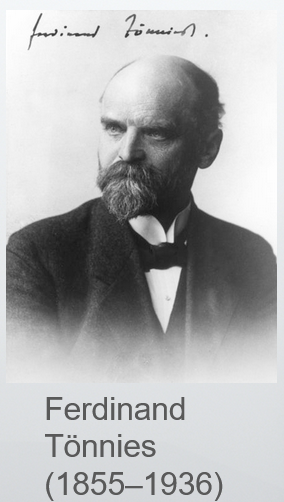
Ferdinand Tönnies argued that, as a matter of historical development, society transitions from an era of Gemeinschaft to an era of Gesellschaft.
A modern society is one in which Gesellschaft, mediated by interests and grounded in calculative and rational will, becomes dominant. Modernization is the process through which Gemeinschaft disintegrates, and it is regarded as an inevitable trajectory.
Ferdinand Tönnies pointed out the negative aspects of both forms: relations of domination in Gemeinschaft, such as slavery, and the lack of intimacy in Gesellschaft, such as deception. On this basis, he proposed Genossenschaft as a more appropriate form of social organization.
#
POINTGenossenschaft:Genossenschaft is a term that means an association formed through contracts based on the free will of its members, typically exemplified by cooperatives. It is characterized by horizontal ties, in which individuals cooperate on the basis of voluntary bonds and a shared sense of solidarity.
#
When Tönnies is reconsidered in this way, his argument appears to largely overlap with that of Émile Durkheim.
The thesis of a transition from Gemeinschaft to Gesellschaft corresponds to the shift from segmentary society (mechanical solidarity) to organized society (organic solidarity).
Furthermore, the proposal to reconstruct Genossenschaft in response to the perceived crisis of social change corresponds to Durkheim’s argument for the reconstruction of intermediate groups.
However, the idea of reconstructing intermediate groups was not unique to these thinkers; it had also been advocated by others, such as clericalists who emphasized the authority of the Church.
(2-2)Putnam’s Critique of Tönnies
Tönnies places a strongly positive valuation on Gemeinschaft, describing it as an authentic form of communal life, while he portrays Gesellschaft in negative terms as a merely temporary and superficial form of social coexistence.
In other words, he advances a normative position that the warm and solidaristic ties characteristic of Gemeinschaft are more fundamental and genuine. However, due to factors such as population growth, technological development, and the expansion of knowledge, the transition from Gemeinschaft to Gesellschaft is regarded as unavoidable.
The sociologist Robert D. Putnam presents cases that challenge Tönnies’s schema that society develops from Gemeinschaft (community) to Gesellschaft (association).
For example, in Italy, the more traditional and solidaristic South tends to exhibit lower levels of civicness, whereas the more artificial and modern North tends to exhibit higher levels of civicness.
Rather than treating the two as a simple dichotomy, Putnam points out that even in highly developed Gesellschaft-type societies, Gemeinschaft-like social relations and forms of solidarity are often sustained.
For instance, civic associations, voluntary organizations, and sports clubs constitute intermediate network-based forms of organization that are neither Gemeinschaft nor Gesellschaft in a strict sense.
Modernization and the advance of Gesellschaft do not entail a complete transition in which the warm, Gemeinschaft-like elements entirely disappear.
In reality, Gemeinschaft-like elements persist within Gesellschaft-type structures. Indeed, in Italy, regions such as the South, where Gemeinschaft-like ties are relatively strong, tend to exhibit weaker civicness, as reflected in indicators such as the number of associations and voter turnout in referenda.
However, it is important that Tönnies also posited Genossenschaft. It is not organized merely as an instrumental association for profit, like a corporation, nor is it passively constituted through given relations such as those between parents and children.
Rather, as in the case of guilds, it emphasizes horizontal relations in which members cooperate on the basis of mutual recognition and solidarity. In this sense, it can be understood as a form of social organization that combines key elements of both Gesellschaft and Gemeinschaft.
If we consider cases in which Gemeinschaft-like elements are adapted to the conditions of Gesellschaft-type life, we can coherently understand situations such as northern Italy, where Gesellschaft has advanced while strong elements of civil society are maintained.
What is crucial here is that Gemeinschaft-like elements have two distinct aspects: those that hinder the development of Gesellschaft and those that are compatible with it. Without distinguishing between these, it becomes difficult to understand how Gemeinschaft-like characteristics can persist within Gesellschaft.
(2-3)Durkheim’s Critique of Tönnies
Émile Durkheim criticizes Tönnies by arguing that, while he largely accepts Tönnies’s analysis of Gemeinschaft, he cannot accept his analysis of Gesellschaft.
This is because Tönnies focuses predominantly on the negative aspects of Gesellschaft and fails to recognize its positive dimensions. In addition, he does not adequately address the common features shared by these two forms of social organization.
The perspective of focusing only on the negative aspects while neglecting the positive ones can later be connected to Jürgen Habermas’s more positive reassessment of modern rationalization, particularly in terms of communicative rationality.
It is also possible that Tönnies’s orientation as a socialist contributed to Durkheim’s critique. One can reasonably infer, in a simplified manner, that Gesellschaft tends to be viewed primarily in negative terms because it is associated with the characteristics of a capitalist society that ought to be overcome, in favor of a socialist society in which cooperation and equality are primary.
Put very roughly, Tönnies treats Gesellschaft as merely an economic aggregate and, in doing so, overlooks its moral characteristics and positive aspects. Both Gesellschaft and Gemeinschaft can function in similar ways insofar as they generate social integration and bonds among individuals.
To quote Durkheim, “It is mistaken to oppose a society arising from a community of beliefs to one based on cooperation, recognizing only the former as possessing moral characteristics while viewing the latter merely as an economic aggregate.”

Tönnies also conceived Genossenschaft as a form that integrates elements of both Gemeinschaft and Gesellschaft, so it is not entirely inaccurate to say that his position approaches that of Durkheim.
Without taking into account the idea of Genossenschaft, his argument may appear overly simplistic, as if it focused only on the negative aspects of Gesellschaft.
Durkheim did not adopt a simple dichotomy; rather, he argued that organic solidarity and mechanical solidarity coexist and support one another.
What concerned him was an imbalance between them, that is, a condition in which modernization produces not free and moral forms of cooperation but constrained and non-moral ones. In this sense, his sense of crisis regarding the imbalance of modern society, and his idea of reconstructing occupational groups such as guilds, can be seen as similar to Tönnies’s line of thought.
References
Recommended Readings
Emile Durkheim「The Division of Labor in Society」
Emile Durkheim「「The Division of Labor in Society」
DK Publishing, Sarah Tomley「The Sociology Book: Big Ideas Simply Explained (DK Big Ideas) (English Edition)」
About the Japanese version of this article
This article is a translation of an article written in [https://souzouhou.com/2024/11/27/durkheim-4-1/]. For detailed references, please refer to this link.

Comments