Summary in the Video
Explanation in the video
The ‘Overview, Summary, or Conclusion’ of this article can be found at the beginning of the YouTube video, so please refer to it.
If possible, we would appreciate it if you could subscribe to our channel to help maintain the site. It serves as motivation for us!
Introduction
This video series is structured around four major works by Émile Durkheim.
- The Division of Labor in Society (1893)
- The Rules of Sociological Method (1895)
- Suicide: A Study in Sociology (1897)
- The Elementary Forms of Religious Life (1912)
First, here is the overall structure of Durkheim’s The Division of Labor in Society.
This article focuses specifically on individualism is detrimental to solidarity.
The remaining topics will be discussed in the next video.
If you find this video helpful, please consider subscribing to the channel. It will motivate me to create the next one.
- Chronology
- What are the bonds that connect people to one another?
- What is division of labor and what are its functions?
- Why does division of labor produce social solidarity?
- [Column] What is sociology?
- The difference between mechanical solidarity and organic solidarity
- The difference between segmentary society and organized society
- Collective conscience and collective representations
- [Column] What is sociological theory?
- Examination of solidarity: repressive law and restitutive law
- Non-contractual elements in contracts
- A society without crime is unhealthy
- [Column] Durkheim’s critique of Tönnies
- Is individualism detrimental to solidarity?
- Coercive division of labor and anomic division of labor
- Intermediate groups as a measure against the adverse effects of modernization
(2-1) Coercive division of Labor
POINTCoercive division of Labor:Coercive division of Labor is a term that means an abnormal form of division of labor in which members of society do not experience satisfaction or a sense of agency in their roles and are compelled to perform them due to social expectations and pressures.
Examples: Cases in which role allocation is enforced based on gender, race, or physical appearance, such as caste systems and class-based systems.
Coercive division of Labor is discussed in relation to the belief in equality. When individuals are unable to obtain a division of labor that corresponds to their abilities, and when they perceive themselves as being compelled into a form of labor that contradicts the ideal of equality under the assumption that equality is socially desirable, that division of labor becomes forced.
Even if a division of labor appears forced from an external perspective, it may not be considered forced if the individual believes that it is appropriate to their own abilities. However, making such a determination is not straightforward.
For example, hereditary traditional performing arts, farming households, or political families are often perceived by others as situations in which roles are imposed; however, in some cases, the individuals themselves genuinely wish to pursue these roles.
Religious caste systems are particularly difficult to evaluate. Moreover, while we tend to assume that social equality is a universal ideal that should apply to all societies, there may be societies that do not share this ideal. In such cases, on what grounds can we justify judging these societies as simply backward, inferior, or underdeveloped?
Such a line of thinking may itself be a form of ethnocentrism.
Alternatively, as the philosopher Michel Foucault suggests, it can also be understood as a case in which individuals are shaped by social structures that induce voluntary submission. In light of this, it becomes necessary to reconsider what is meant by human agency, subjectivity, and free will.
If individuals find value in a role as appropriate to themselves and alternative options are genuinely available, it may be possible to judge that the division of labor is not forced.
However, if a person’s will and sense of agency have been shaped or controlled by their surrounding environment since early childhood, such a judgment becomes considerably more complex.
From this perspective, the issue connects to the ideas of the psychologist Alfred Adler, who argued that an individual’s personality pattern (lifestyle) is largely formed in early childhood. This is often expressed proverbially as “the soul of a three-year-old lasts until one hundred.”
Accordingly, it is necessary to consider, as part of a broader analytical framework, what counts as an individual’s will and under what conditions a division of labor should be regarded as forced.
The abnormality of Coercive division of Labor lies in the fact that it does not generate social solidarity; in other words, it does not contribute to social integration, although this may be a matter of degree.
When individuals engage in a division of labor while perceiving it as imposed by social forces rather than chosen voluntarily, social solidarity is less likely to emerge.
In an extreme case, such as a society formed by gathering slaves, social solidarity is unlikely to emerge, and an atmosphere of tension and conflict tends to prevail.
In a more contemporary context, when immigrants are unable to obtain stable or desirable employment and feel that they are confined to low-paid, routine labor, this can also undermine social solidarity.
At the same time, even when immigrants come to obtain higher-paying jobs, this may still have negative implications for social solidarity at the level of society as a whole. Evaluating such outcomes as positive or negative is not straightforward when viewed from a broader perspective.
Thus, it is not sufficient to assume that any form of division of labor is acceptable; rather, it is important to establish an appropriate and normal division of labor, and achieving this balance is inherently difficult.
Émile Durkheim is characterized by an orientation that places importance on what is commonly referred to as meritocracy.
Meritocracy is a term that means a social and organizational principle in which evaluation and rewards are determined based on an individual’s abilities and achievements. Accordingly, it is essential that individuals are not prevented, by any kind of barrier, from attaining a social position that corresponds to their abilities within the social framework.
For example, a view such as “not hiring someone because of their race” would be considered contrary to meritocracy. But what if one were presented with seemingly objective statistical data about different racial groups?
Even in such cases, there is a risk of committing the ecological fallacy identified by William S. Robinson, that is, the error of attributing characteristics of a group to individual members.
Suppose that in a certain region, a rise in criminal activity among foreign nationals from a particular country has recently become a social issue.
Now imagine that, at a given company, a foreign applicant who has entered the country legally, whose background indicates no significant differences in ability or conduct compared to others, and who is in fact superior to other candidates, comes for an interview.
If one were the interviewer, would one hire this applicant? If not, would such a decision be based on a justifiable reason?
More broadly, on what grounds do we criticize people of other races, or refrain from assisting them simply because they belong to a different racial group?

This issue is also related to what is commonly referred to as nationalism. In a broader sense, it may be understood as a form of egoism in which the nation is conceived as if it were a single person.
For example, whether the current actions of Russia should be interpreted as a form of egoism, or whether they are leading toward self-destruction, is not something I can determine. However, such cases may offer useful insights for thinking through these kinds of real-world problems.
According to the sociologist Yusuke Maki, the poet Kenji Miyazawa was a figure who sought to liberate the self.
A stance of living solely for oneself is referred to as egoism. At the same time, human beings are sexual beings and thus capable of loving others; in this sense, they are also beings who live for those they love.
However, even the attitude of living not only for oneself but for a loved other can be understood as an expanded form of egoism. This is because it can give rise to hostility, indifference, or jealousy toward those outside the circle of loved others.
This applies not only to romantic relationships between two individuals, but also to relationships such as the family or the nation. It is an attitude in which attacks on one’s partner or fellow nationals are felt as attacks on oneself, and in which one’s own group is regarded as taking priority.
Religion can be understood as an attempt to overcome this form of egoism grounded in sexuality, insofar as it creates relationships that transcend particular nations.
However, religion can also generate indifference or hostility toward those who belong to different religions; in this sense, religion itself can likewise be regarded as a form of expanded egoism.
The poet Kenji Miyazawa is said to have avoided loving any particular individual and even refrained from adhering to religion. Whether such a liberation of the self is possible within the constraints of real social frameworks is unclear.
However, it may be reasonable to argue that some mechanism is necessary to maintain a balance so that egoism does not become excessive.
(2-2) Anomic Division of Labor

POINTAnomic division of labor:Anomic division of labor (unregulated division of labor) is a term that means an abnormal form of division of labor that arises under conditions of anomie. In The Division of Labor in Society by Émile Durkheim, anomie refers to a state in which differentiated social functions are not properly integrated.
Examples: Conflict between labor and capital, and excessive fragmentation of occupations.
The difference in emphasis regarding anomie lies in the fact that, in The Division of Labor in Society by Émile Durkheim, the focus is on a state in which differentiated social functions are not integrated, whereas in Suicide, the emphasis is on the mismatch between the expansion of desires and social norms brought about by rapid social change.
Both the problem of too little freedom (excessive regulation) and the problem of too much freedom (insufficient regulation) are identified, and they share a common feature in the breakdown of balance.
In both cases, the issue can be understood in terms of desire: desires are either excessively suppressed or excessively expanded, resulting in a state of frustration. This is particularly related to the intensification of aspirations toward equality.
(The Division of Labor in Society) Inequitable regulation refers to cases in which social inequality unjustly suppresses individual desires, leading to social unrest and conflict.
It is argued that such unequal regulation should be weakened, or that regulation aimed at correcting inequality should be strengthened.
(Suicide) Expansion of desires refers to situations in which social norms weaken, individual desires expand excessively, and this leads to feelings of powerlessness and despair, ultimately contributing to an increase in suicide rates.
It is argued that regulation should be strengthened in order to appropriately restrain individual desires.
Importance of norms: Social norms function to regulate individual desires in a balanced manner and to maintain social order. When regulation is either too strong or too weak, abnormal forms are more likely to emerge.
Under such conditions, what Karl Marx termed alienation tends to advance, while in the framework of Émile Durkheim, society is more likely to fall into a state of anomie. In contemporary society, what proportion of people are actually engaged in work that provides a genuinely intrinsic sense of fulfillment?
This also relates to the words of Morris Berman: “How many of us perceive ourselves as whole beings? Is it not the case that we play roles assigned by society and, wandering through intricate rituals and games of interaction, diligently weave a false self?”
In short, this points to the attenuation of what he calls “participatory consciousness.”
The sociologist Michio Nakajima presents the conflict between labor and capital as an example of anomic division of labor, whereas Masachi Osawa discusses it as class struggle within the framework of Coercive division of Labor.
If anomie is defined as a state in which differentiated social functions are not integrated, then class struggle can be understood as a condition in which the two functions of labor and capital are not integrated, and thus it fits within anomic division of labor.
At the same time, if wage laborers perceive their position as unequal and experienced as imposed or constraining, it can also be understood as Coercive division of Labor. In this sense, the two are closely related and may coexist simultaneously.
The commonality between anomic division of labor and Coercive division of Labor can be understood in terms of their relation to the belief in equality. Let us consider a simplified formulation.
Class struggle can be interpreted as arising from the belief in equality and the gap between that belief and social reality.
But how does this belief in equality relate to abnormal forms of division of labor characterized primarily by instability caused by economic crises or by feelings of alienation resulting from the excessive fragmentation of occupations?
For example, when many people experience downward mobility due to an economic crisis, they may become dissatisfied with their social position, and the belief in equality may become more salient.
Similarly, when occupational roles become highly fragmented, individuals may come to feel that they ought, in principle, to be engaged in more meaningful work, thereby heightening their awareness of the ideal of equality.
That said, Coercive division of Labor is, comparatively speaking, more appropriately illustrated by the conflict between labor and capital. This is because the aspiration toward equality tends to be transformed not into a sense of powerlessness, but into a kind of active force or hope.
What is emphasized here is not the absence of proper regulation, but the presence of improper regulation and its constraining character.
In contrast, in the case of anomic division of labor, the emphasis is on the absence of appropriate regulation, and the resulting condition is closer to powerlessness and anxiety than to an active force.
In any case, what they share is an aspiration toward equality, and, as Émile Durkheim assumed, both can lead to social disintegration, dysfunction, and disorder.
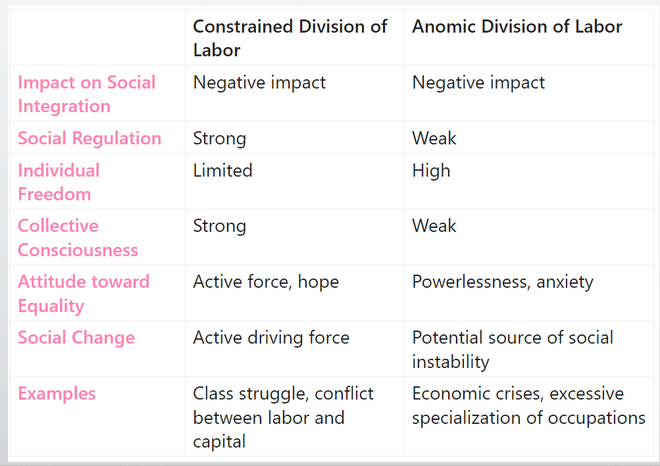
This may be an oversimplification, but it has been illustrated in a diagram for reference.
Rather than a simple dichotomy, more complex configurations of abnormal division of labor may also exist.

For example, there may be cases in which individuals are negatively affected by an economic crisis, are engaged in highly fragmented occupations, and at the same time participate in class struggle.
In such situations, it is necessary to analyze them on a case-by-case basis, in conjunction with the specific social conditions involved.
(2-3) Is the conflict between labor and capital abnormal?
Many scholars are critical of Émile Durkheim for classifying the conflict between labor and capital as “abnormal.”
For example, the sociologist Masachi Osawa argues that “the distinction between normal and abnormal division of labor is conceptually subtle.”
In contrast, Karl Marx regarded class struggle as a “normal” condition, whereas Durkheim viewed it as “abnormal.” Osawa illustrates this difference with the apt metaphor of “two people looking at a gray painting, one saying ‘Isn’t it white?’ while the other says ‘No, isn’t it black?’” This analogy has a distinctly phenomenological quality.
This will be discussed in detail in Suicide, but Masachi Osawa also considers the distinction between “egoistic suicide” and “anomic suicide” to be subtle. For this reason, the distinction between Coercive division of Labor and anomic division of labor may likewise be regarded as ambiguous.
Interpreting something “gray” as either black or white can be understood, in the sense of Karl Mannheim, as relying on what is called ideology. In the terms of Émile Durkheim, this corresponds to collective consciousness (collective representations).
For example, the sociologist Hideaki Omura raises the point that Durkheim’s classification of division of labor into “normal” and “abnormal” goes beyond mere observation and involves value judgment.
The question then arises: on what basis is a division of labor characterized by conflict between labor and capital classified as “abnormal”? Such judgments are shaped by the relative value systems of each society, and it is argued that there is no objective standard that allows “normal” and “abnormal” to be determined as matters of fact beyond such socially conditioned perspectives.
Émile Durkheim argued with regard to “crime” that it cannot be defined as such by any objective content other than what collective consciousness designates as crime/non-crime.
In a similar way, it can be asked whether the conflict between labor and capital can also be classified as normal/abnormal without relying on any objective criteria. The same issue will also be relevant to the “happiness hypothesis,” which will be discussed in the next section.
References
Recommended Readings
Emile Durkheim「The Division of Labor in Society」
Emile Durkheim「「The Division of Labor in Society」
DK Publishing, Sarah Tomley「The Sociology Book: Big Ideas Simply Explained (DK Big Ideas) (English Edition)」
About the Japanese version of this article
This article is a translation of an article written in [https://souzouhou.com/2024/11/27/durkheim-4-1/]. For detailed references, please refer to this link.
Comments