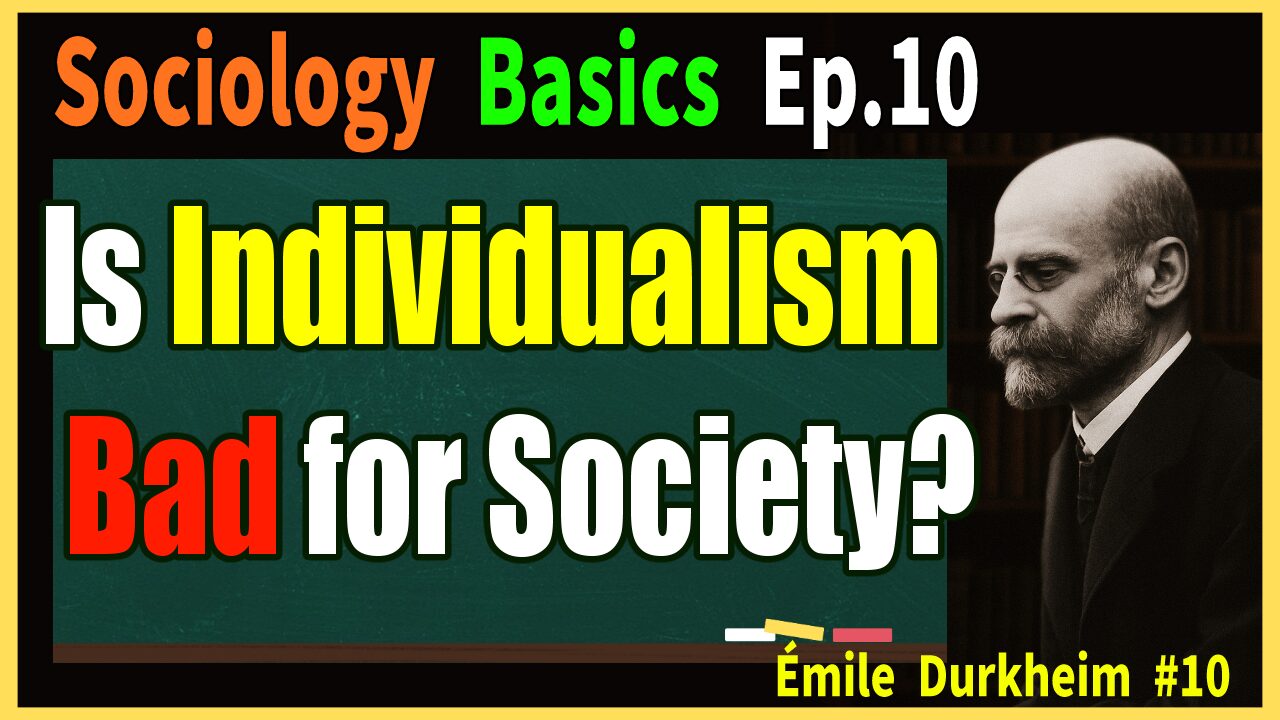
Summary in the Video
Explanation in the video
The ‘Overview, Summary, or Conclusion’ of this article can be found at the beginning of the YouTube video, so please refer to it.
If possible, we would appreciate it if you could subscribe to our channel to help maintain the site. It serves as motivation for us!
Introduction
This video series is structured around four major works by Émile Durkheim.
- The Division of Labor in Society (1893)
- The Rules of Sociological Method (1895)
- Suicide: A Study in Sociology (1897)
- The Elementary Forms of Religious Life (1912)
First, here is the overall structure of Durkheim’s The Division of Labor in Society.
This article focuses specifically on individualism is detrimental to solidarity.
The remaining topics will be discussed in the next video.
If you find this video helpful, please consider subscribing to the channel. It will motivate me to create the next one.
- Chronology
- What are the bonds that connect people to one another?
- What is division of labor and what are its functions?
- Why does division of labor produce social solidarity?
- [Column] What is sociology?
- The difference between mechanical solidarity and organic solidarity
- The difference between segmentary society and organized society
- Collective conscience and collective representations
- [Column] What is sociological theory?
- Examination of solidarity: repressive law and restitutive law
- Non-contractual elements in contracts
- A society without crime is unhealthy
- [Column] Durkheim’s critique of Tönnies
- Is individualism detrimental to solidarity?
- Coercive division of labor and anomic division of labor
- Intermediate groups as a measure against the adverse effects of modernization
(2-1) Durkheim’s concern about individualism
POINTIndividualism:Individualism is a term that means the ideology or belief that an individual’s rights, independence, and self-realization should be prioritized over the interests of the group or society.
Its opposite, which emphasizes the welfare or harmony of the group or society, is called collectivism.

For example, choosing a career based on personal preference rather than family or societal expectations, or valuing freedom of religion and expression, can be considered individualistic attitudes in contemporary contexts.
Durkheim’s evaluation of individualism differs between his work The Division of Labor in Society and his later writings (such as Individualism and the Intellectuals).
In short, he was critical of individualism in the former and more supportive in the latter. The question then is: what aspects of individualism were considered problematic and criticized by Durkheim in The Division of Labor in Society?

In segmentary societies, collectivism was considered a defining characteristic. Society was prioritized over individual freedom, personality, and interests. As with Durkheim’s definition of the collective consciousness, shared beliefs and sentiments common to the average members of society were emphasized.
As societies became more organized, individualism gradually became more dominant than collectivism, meaning that individual freedom, personality, and interests were increasingly valued.
Consequently, the aspect of each individual sharing the “common beliefs and sentiments” became weaker, and diversity was increasingly highlighted, as reflected in the idea that “everyone is different, and that is good.”
Durkheim argued that the collective consciousness has not completely disappeared in modern society. In more organized societies, the collective consciousness became more general and abstract.
While in segmentary societies, individuals were regulated by concrete daily practices and religious norms, in organized societies, they increasingly relied on universal values such as awareness of human rights, freedom, and equality.
Instead of concrete, singular beliefs such as “the teachings of a particular religion,” “the authority of a certain ruler,” or “ancient traditions are correct,” the average consciousness comes to be defined by more abstract values such as freedom, equality, individuality, and diversity.
In other words, it can be described as an era in which individuals must choose for themselves what values to prioritize.

Durkheim argued that as the collective consciousness becomes more abstract, it promotes the fragmentation of the individual. When norms are less concretely specified, individuals gain greater freedom and tend to prioritize themselves over society.
This can also be understood in relation to the tendency in modern art to value originality—individuality and difference from others—over realism.
Durkheim also stated that “the individual becomes the object of a kind of religion.” The individual comes to be regarded as a sacred, valuable, and inviolable being, and society should not constrain or violate their rights.
Importantly, the dignity, sense of responsibility, irreplaceability of each individual, and the interdependence among individuals generate a force that makes individuals aware of society, producing what Durkheim called organic solidarity.
However, as organic solidarity became more dominant than mechanical solidarity, it became more difficult for individuals to consciously recognize this social force.
People tend to take for granted institutions such as the police, laws, morality, or even small acts of kindness.

It is often only when “ruptures” occur, such as natural disasters or other crises, that the significance and presence of these social and collective elements are strongly perceived.
To use a metaphor, one rarely notices a windowpane until it breaks; normally, it is transparent and taken for granted.
For example, when one hears statements like “it is acceptable to sacrifice you as one individual to save 100 people,” I feel a sense of discomfort. This may be because I hold individualistic beliefs. Many others probably feel the same.
More concrete examples make this intuition clearer: “It is acceptable to harass you for the company’s profit,” “It is acceptable to force you to shave your head for school discipline,” “It is acceptable to indirectly compel you into unwanted romantic relationships through measures like a single-person tax to address declining birthrates,” or “Parents may take away most of a child’s freedom for their own good.”
- The awareness that “the individual is a sacred being” constitutes the average, shared consciousness (collective consciousness) in the modern and contemporary era.
- Durkheim expressed concern in The Division of Labor in Society that individualism indeed “binds us to each other,” but “does not bind us to society.” He went so far as to state that the ties (solidarity, bonds) produced by individualism are not true social bonds.
(2-2) What is utilitarian individualism
In Individualism and the Intellectuals, Durkheim classified individualism into three types: utilitarian individualism, idealistic (or metaphysical) individualism, and moral individualism.
POINTUtilitarian individualism:Utilitarian individualism is a term that means a perspective that views society merely as an “association based on economic interests and the pursuit of individual self-interest,” and holds that when each person acts freely, it will ultimately contribute to the overall benefit of society.
Durkheim had Herbert Spencer in mind as an example.
The difference from the utilitarianism of Mill or Bentham lies in the fact that Spencer was influenced by Darwin’s principle of natural selection and emphasized individual freedom and natural competition. Spencer did not take the happiness of others or society as a direct guiding principle; rather, he believed that when individuals freely develop their abilities and pursue their self-interest, it would ultimately contribute to the progress and well-being of society as a whole.
Durkheim criticized Spencer’s disregard for communal consciousness. He regarded this form of utilitarian individualism as “a vulgar commercialism that reduces society to nothing more than a vast mechanism of production and exchange” and considered it unacceptable.
Here, commercialism generally refers to a perspective in which commercial success and economic gain are valued above other social or moral considerations.
(2-3) What is idealistic (or metaphysical) individualism
POINTIdealistic individualism:Idealistic individualism is a term that means a perspective that grants individuals the freedom to pursue “moral values that apply equally to all individuals,” rather than merely seeking their own self-interest.
However, such values are not considered to exist beyond the individual; they are understood to be discerned from within the individual through reason, mind, or consciousness.
Strictly speaking, this is “idealistic individualism,” with Immanuel Kant and Jean-Jacques Rousseau in mind (whether they are strictly idealists is set aside here, focusing only on this aspect).
Idealism generally refers to the perspective that “the mind shapes reality,” or more broadly, that the mind and consciousness are central.
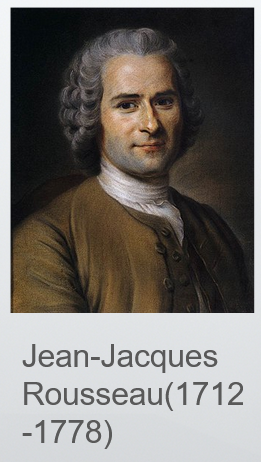
According to Durkheim, based on the ideas of Kant and Rousseau, “moral values that apply equally to all individuals exist a priori.”
The term a priori refers to a form of knowledge or recognition that exists prior to experience.
From an idealistic perspective, reason and morality are not something we create through society; rather, they are innate, and the emphasis is on discovering them using the power of reason. For example, one form of idealism, solipsism, holds the position that the existence of others or the external world cannot be known with certainty.
René Descartes’ statement, “I think, therefore I am,” is close to this position. However, Descartes differs slightly from solipsism in that he attempted to prove the existence of God, an objective reality beyond the mind.

For example, in the Declaration of the Rights of Man and of the Citizen during the French Revolution of 1789, it was asserted that all people are born with universal rights such as freedom and equality.
The idea of freedom and equality is not something created by individuals or society, but is considered to be inherently innate from birth, which is extremely important in this context.
The concepts of freedom and equality are not considered to be created through our communication with others or our actions upon material objects.
This perspective may also reflect a caution against allowing authorities to arbitrarily define individual rights in specific, concrete ways. In fact, it is necessary to consider that in certain societies, the belief that “rights are guaranteed only to a particular ethnic group” can socially emerge.
(2-4) What is moral individualism
POINTMoral individualism:Moral individualism is a term that means a perspective that holds that individuals are free to pursue moral values that apply equally to all and that this freedom should be respected. Unlike idealistic individualism, these values are not innate but are acquired and socially formed. This perspective is sometimes referred to as “socialized individualism.”
In short, moral individualism holds that capacities such as reason and values like freedom and equality are not innate but socially created. Individuals express their individuality within the framework of values (morality) that society deems desirable.
While Durkheim recognized certain similarities with idealistic individualism, he opposed the view that moral values can be grasped solely by the reason of isolated individuals, emphasizing instead that they arise through society, beyond the individual.
One might argue, in an extreme thought experiment, that isolated individuals cannot discover such moral values. From a Simmelian sociological perspective, it could be imagined that one experiences freedom only through the contrast with social constraints felt in communication with others.
Durkheim considered a state entirely without social constraints undesirable; he viewed as healthy and genuinely free the attitudes in which, under constraint, one refrains from actions because they violate morality or acts because they conform to it.
Fundamentally, the “individual” is produced by society; without society, there would be no individual, only a “mere biological being.” Society guarantees freedom and equality to the individual, and this is concretely connected to the emergence of the state.
The French Revolution and the formation of the modern nation-state occurred around the same period and are closely related in this regard.
In short, this perspective seeks morality not in the individual, but in society. For example, no one can perform a division of labor entirely alone; it requires multiple people and groups.
Through the process of collective labor, the collective consciousness is formed, and moral values emerge spontaneously.
The idea is not that something buried deep within the individual is simply uncovered, but that it is co-created collectively. If the development of the division of labor preceded the French Revolution, one could say that it helped prepare some of the social conditions for the Revolution.
As seen in the context of the Declaration of the Rights of Man, there is a danger that if the state holds too much power, the collective consciousness may veer in extreme directions.

The distance between the state and the citizens is crucial; if it is too close or too distant, extremes are more likely.
For this reason, Durkheim emphasized intermediate associations, such as professional groups, which both restrain the state’s excesses and allow for the pursuit of individual freedom.
(2-5) What is the science of morality
Although collective consciousness and moral values are unconsciously perceived by individuals, it is difficult to clearly make them conscious or put them into words.
Durkheim believed that the role of “science” is precisely to achieve this consciousness and articulation. He especially emphasized a science that grasps moral values such as solidarity—that is, social facts—and uncovers the “laws of morality.” This science is what Durkheim called sociology, or the science of morality.
Durkheim believed that by making what exists unconsciously conscious, people would become more aware of society, morality, and solidarity, and that social integration would thereby be strengthened.
Durkheim stated about moral individualism that “members of the same social group would no longer have anything in common besides the attributes that constitute their general personality,” which is somewhat difficult to understand. The important point is that we share in common the “attributes that constitute general personality.” However, what exactly are these?
The “attributes that constitute general personality” are not understood in the Kantian or Rousseauian sense; rather, they are produced by a group in a particular society at a particular historical time and can only be recognized within the group as collective consciousness.
For example, in The Division of Labor in Society, such attributes include social responsibility, cooperativeness, and interdependence. These are rooted in organized society and function both to regulate and empower individuals.
In a more visible form, Durkheim particularly cited “repressive law.” In repressive law, “cooperation” is considered its main value. In more abstract terms, this corresponds to freedom and equality.
In the context of the division of labor, this means that there is value in both the freedom to choose among diverse occupations and the equality of opportunity to make those choices, with these two concepts being closely related.
Durkheim’s view of individualism in The Division of Labor in Society can be understood as somewhat negative, seeing it as “a situation in which individuals become divided because people try to escape social constraints as much as possible and cease to consciously perceive society in concrete and clear terms.”
This perspective is closer to a critique of utilitarian individualism: it produces fragile bonds that cannot create genuine social ties.
Freedom and equality are certainly valuable, but without any constraints, they can become excessive and tend to lead to negative effects on social integration, such as anomy (lack of regulation) or egoism (self-centeredness). Suicide can also arise from the gap between excessive desires for freedom and equality and the reality in which they are not fulfilled.
However, if individualism takes the form of moral individualism, it should be viewed more positively, and Durkheim expected that it could help create “genuine social bonds.”
Individualization works successfully when it is supported by the morality of the society; without such support, it does not function properly. Similar to Parsons, Durkheim also held a Kantian idea that “the very orientation toward norms is freedom.”
However, unlike Kant, he did not consider these norms to be innate; rather, he saw them as acquired and socially formed, and he sought to study their emergence scientifically rather than speculatively.
Durkheim argued that moral individualism makes it possible to “bind us to society.” He even stated that it is “the only system of beliefs that can establish moral unity in our country going forward.”
Durkheim’s moral individualism is not a form of collectivism that denies individual rights and simply prioritizes society. Rather, he held that “individual rights should be affirmed, and if they are not, society (in France at the time) cannot be maintained.”
The attitude is that “individual rights should be exercised based on collective consciousness and social realities shared by society, such as freedom, equality, and a sense of responsibility.”
It can be easier to understand by imagining a harmonization—or aufheben—of individualism and collectivism. This is sometimes described as a defense of liberalism from a communitarian perspective.
For example, choices regarding clothing, hairstyle, occupation, favorite foods, preferred types of people, favored fields of study, or preferred spaces are areas where individuality is broadly acceptable, and people are free to choose and pursue them.
However, actions that harm others, display a lack of responsibility, waste food, or disrupt social order should not be permitted, as they violate values that are held in common as part of the collective consciousness of each society.

The freedom to wear flashy clothing to a funeral, or to not attend at all, is not considered an acceptable freedom from the perspective of the country I live in.
Of course, there are countries where such behavior is allowed, so it is always necessary to take into account the realities and ideals of the specific society.

Of course, taken literally, this could be seen as a conservative view, but Durkheim also held innovative ideas.
He did not argue that people should simply preserve the existing collective consciousness and have freedom only in that direction.
Morality—the attributes that constitute general personality—is not merely a set of established facts; it can also be understood in an idealistic sense.
This can be related to Kant’s notion of regulatory ideas. In fact, the philosopher Kant is also a presupposition in Jürgen Habermas’s concept of the ideal speech situation in sociology.
In reality, there are often cases where things contradict the ideal, and there is room for improvement. Changes in social or physical conditions may require corresponding adjustments in reality.
However, if only the prevailing collective consciousness were considered correct, public opinion might be treated as inherently right (setting aside the question of whether public opinion can truly reflect the existing collective consciousness).
For example, in a society, people may collectively hold the ideal that dictatorship is wrong, yet in reality, a collective consciousness may develop in which dictatorship becomes unavoidable. Some individuals may resist such non-ideal dictatorship, but the likelihood of tragic consequences is high.
This situation can also apply to small societies, such as schools, where bullying occurs. Students may understand the social ideal that “bullying is wrong,” yet struggle with the social reality of conformity pressure, feeling compelled to participate to avoid isolation from the group.
It is sometimes acceptable to adopt a critical stance toward the realities of collective consciousness, and doing so does not automatically violate morality.
Durkheim likely believed that the ability to compare ideals and reality could be grasped more reflectively and concretely through “science.”

For example, in this process, the latent functions of bullying—similar to the study of crime—might become apparent (without implying that bullying is morally good). However, as sociologist Robert Merton demonstrated, determining whether the functions or dysfunctions prevail, and calculating their net effect in a complex modern society, is difficult.
Durkheim argues that “ideals” should not be detached from reality or empty abstractions; they must be grounded in the actual social world.
He is also critical of the idea that such ideals can be discovered through mere individual speculation. For example, the ideal that dictatorship is wrong is itself rooted in the reality of existing dictatorships.
However, the question remains: from what perspective can we judge whether a given “ideal” is genuinely good, and to what extent can this be understood scientifically?
We need to take the “science of values (morality)” seriously—for instance, this is an approach explored by architect Christopher Alexander.
References
Recommended Readings
Emile Durkheim「The Division of Labor in Society」
Emile Durkheim「「The Division of Labor in Society」
DK Publishing, Sarah Tomley「The Sociology Book: Big Ideas Simply Explained (DK Big Ideas) (English Edition)」
About the Japanese version of this article
This article is a translation of an article written in [https://souzouhou.com/2024/11/27/durkheim-4-1/]. For detailed references, please refer to this link.

Comments